Monday, January 18, 2016

Nevis and an Overnight Passage


We simply love the island of Nevis.  It is one of two islands that together make up the Nation of St. Kitts and Nevis.  They couldn’t be more different.  St. Kitts is populated and the main town is bustling.  They have invested in the infrastructure to accommodate cruise ships, and the get a lot of big ones.  Our experience is that the islands that are infested with cruise ships just aren’t very pleasant for cruisers.  The interactions between visitors and local people become strictly a matter of moving money from one person’s pocket into another’s.

Nevis, on the other hand, is small, rural and peaceful.  They get a few very small cruise ships, but they haven’t affected the atmosphere much (except for raising taxi prices).  There is a big Four Seasons resort with a big and expensive golf course (we’ve never played it).  In addition, several old plantation houses have been turned into high-end hotels.  These are just lovely—we make a point of visiting a different one for lunch each visit.

The beaches on Nevis are outstanding.  We often take advantage.
The only downside to Nevis is the infrastructure for landing your dinghy.  They have a large and very busy ferry dock, since the main way to get to Nevis is a ferry from St. Kitts.  Next to this is another dock mainly dedicated to fishermen.  In between these is the space for dinghies.

There are two big problems with this arrangement.  First, the space for dinghies is sometimes usurped altogether by boats landing passengers from the occasional cruise ship, or by fishermen landing their catch.  Second, and even a bigger deal, is the surge.  This space is situated so that large waves come crashing inside, and ricochet back after hitting the shore.  It could be swell from the far ocean, or it could be wake from a ferry or other boat.  In either case, it sends your dinghy smashing and bashing into the dock, into other dinghies, into other boats.  We have seen a person’s dinghy completely destroyed as it was forced under the dock by the surge and then caught on a rising tide.

We cope by using a stern anchor with a long rode, and by simply avoiding the dock when things are particularly bad.  We have sometimes had to land on the beach and take a long walk to town, though this year that wasn’t necessary.

A friend we met on Bonaire, Margie Benziger, found out we were on Nevis and got very excited.  She had spent time there, and worked on public relations for the island.  A good friend of hers is still on Nevis (most of the year), working for The Hermitage, one of the plantation hotels.  Helen Kidd is a Scot, extremely friendly, and also excited that we had come and introduced ourselves.

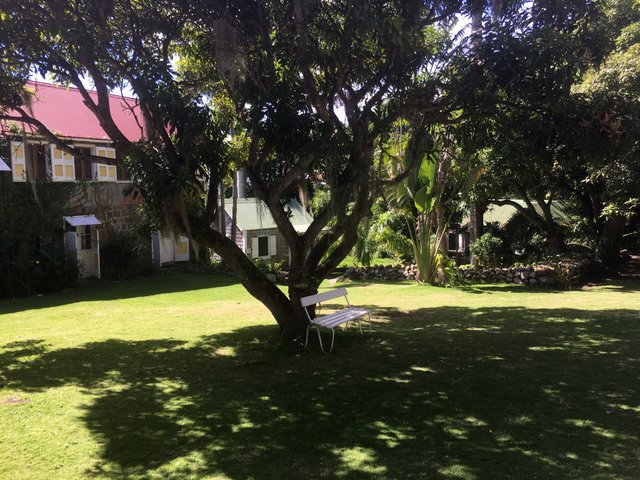
The Hermitage is a lovely place.  It still has the original plantation house, built in 1670.  This is constructed of wood and is one of the oldest wooden structures in the Caribbean.  The grounds are beautifully landscaped and all of the buildings are in the traditional Caribbean style.  We had a very pleasant lunch there, and spent some time exploring the grounds.

One of our favorite activities on Nevis is hiking.  In the past we have taken a couple of hikes with a guide.  Nevis is shaped more or less like a sombrero – A tall peak in the center surrounded by a large flat area around it.  This time we decided we would try hiking to the top of Mt. Nevis.  That’s 3200 feet above sea level.

We inquired at the tourist office and they hooked us up with a guide.  We didn’t realize it at first, but they had called Reggie Douglas, who took us for a mountain bike expedition a couple of years ago.  It was great to see him again.  He runs Nevis Adventure Tours and Green Edge Bike Shop (greenedge2011@hotmailcom)

The “hike” to the summit is better described as a “climb.”  It is entirely natural, no steps or guard rails.  It is steep, it is muddy, and it is slippery!  The only aids to climbing, besides lots of roots and branches, are many ropes that have been installed by the handful of guides who lead people up.  Think steep like climbing a ladder.  A muddy, slippery ladder.

Reggie was great.  He has gotten many, many people (even beginners) up to the top and back down again.  It seemed he had a pre-thought-out plan for nearly every step of the way, and he was with us and coaching us all the way up and all the way down.  The round trip took about four and a half hours.  We were tired when we reached the bottom, but it was a fantastic experience.  The scenery is breathtaking, even though our view at the summit was blocked by a dense cloud.

 A final cool thing about our visit is that we saw the Green Flash three times!
After several excellent days on Nevis, it was time to continue our journey down the Caribbean chain.  Our next stop was to be Guadeloupe.

This is a passage of more than 70 nautical miles.  At 6 knots, that’s a long day.  In the past, we have tackled this by leaving well before dawn, sailing hard on a single tack, and arriving just before dark.  That left us competing with other boats for the limited anchorage space.

We didn’t like leaving in the dead-dark morning hours.  There are fish trap buoys everywhere and even some fishing boats anchored without lights.  Its nerve wracking until you get several miles from Nevis.
This year, we had another problem.  The weather forecast was for light winds from an unfavorable direction, which means tacking.  I guessed we might sail as far as 100 miles to reach Guadeloupe.

So we decided to do another overnight passage.  Funny how something that seemed so scary a couple of years ago now seems pretty normal.  We left just before 4 pm, figuring on a 15-16 hour passage given the forecast.  As it so often happens, the forecast was wrong.  We had quite strong winds, and from a relatively favorable direction.  Oh no!  What would we do if we arrived at 3 in the morning?

Well, not to worry.  As we passed the island of Montserrat (with its active volcano and intense sulfur smells), the weather returned to the forecast.  We had light winds, ended up having to tack, and arrived just at sunup.  A passage of 85 miles in 15 hours.  We finished a second time very tired, but happy to have made the journey.

Monday, January 4, 2016

Moving on and close calls

Location--Grand Case, St. Martin

Just 30 minutes from Marigot Bay, we arrived on the afternoon of Jan 2nd.  Lots of boats were finishing their holidays, so the harbour was fairly full.  It's a great town, full of excellent restaurants, beach bars, rib joints, all the way to gourmet.

When we anchor or pick up a mooring, we (meaning David) puts on his goggles, and snorkels to inspect how we are attached to the bottom.  A critical factor is called "scope", or how much anchor chain or mooring line there is from the the boat to the bottom.  The factor we use is usually 5 x the depth.  Not everyone does, this, and for many the amount of chain or line they let out to anchor is not sufficient, especially if there is a lot of wind or wave action.  Hence, the close call...

We were eating lunch in the cockpit (at the rear or stern end).  The boat points forward into the wind.  I heard someone playing music, and it kept getting louder.  I looked towards the front of the boat and saw a large catamaran not 10 feet away.  Since there was music playing, we assumed there was someone on board and they were manouevering (badly)--NOT!  Within moments, the boat was slipping sideways along our side.  David rushed for our dinghy and I went forward to try and push them away.  The solar panels from their boat started overlapping our side lines.  I quickly changed my position, getting between two several on boats grinding together is not a good idea.  At that moment one of our neighbors arrived on his dinghy, and with a fortunately swing in the wind and a push from his dinghy, we were free.

The catamaran continued to be blown out to sea.  The rescuer attached his dinghy to the catamaran, started the engine and found the controls for the anchor.  One thing the "sailors" had done correctly is leave the keys in the engine, an important safety precaution for just this kind of occasion.

David radioed a "Security" call about the boat adrift and then went ashore from bar to bar asking (unsuccessfully) for anyone on the boat "Blue Cat".   About half an hour later, the crew returned to the boat.  We assume that the charter company heard the radio alert and phoned the charterers.  We expected a visit from them to inquire about our well-being or for them to visit the rescuer on his boat, but no such thing.  Oh well...

A little adrenalin at lunchtime goes a long way.  We ended the day in Il Nettuno, with a nice bottle of Bordeaux and an excellently prepared seafood dinner.

Wednesday we leave for St. Barth's, we may be there for a few days, the wind is going to be very light (either too much or too Little!) and from the southeast, not the best for moving on to St. Kitts-Nevis.   We should be able to be online in St. Barth's, so until then!

Thursday, December 31, 2015

It's New Year's Eve in St. Martin

We have had quite a go of it in 2015...hopefully the weather will calm down just a bit so that our journeys to the next islands are not so boisterous.

While we were in Virgin Gorda, we met up with three other Outbound yachts, the broker from Barrington RI and the owner of the Outbound company.  It was the first time we have seen another Outbound in the same harbor since 2010.  Quite a nice reunion...

We left Virgin Gorda on Monday the 28th at noon in a tiny weather window with slightly reduced winds and waves.  The way from the British Virgin Islands to St. Martin is pretty much directly into the wind, so in order to sail we have to tack back and forth, or else crash and bang at a slower speed with the engine.  We sailed 130 miles to cover a 75 mile distance, at just about 24 hours at sea.  Luckily we did not encounter any squalls during the night hours, but boy at 5 am did the wind start howling and the rain start slashing...the only advantage to the hard rain is that the salt we accumulated got washed off nicely...

Anyway, we are now in Marigot Bay on the French side of St. Martin, using the internet in Shrimpy's laundry, a well-known boater hang-out.  We had a lovely lunch yesterday in Marigot, full-service midday meal for 12 euro each, including the wine and beer.  

Today we are grocery shopping and then planning on a quiet evening on the boat, until the fireworks from shore wake us up.  We should have an excellent view of any displays in both Marigot and Simpson Bay.

Our next stop will be St. Barths, and again our departure is completely weather dependent...

Best wishes to all for 2016.  

Gretchen

Tuesday, December 22, 2015

HAPPY HOLIDAYS ALL

This post is short and sweet

We have had a great time in both the US and British Virgin Islands.  At the moment we are in the North Sound on Virgin Gorda, waiting for cooperative winds and waves to make our way overnight to St. Martin.  We have spent a lot of time away from the interweb...and also out of cell phone range.  Hiking, snorkeling and of course, going through the boat chore list.

In the meantime, we hope that you enjoy time with friends and family, with a farewell to 2015 and best wishes for 2016.

love to all
David and Gretchen

Tuesday, December 8, 2015

More Vieques on to Culebra


08 December 2015

Puerto Rico continued….

The Ponce Fishing and Yacht Club hosted a sailboat regatta the weekend before Thanksgiving.  Our fellow crew member, Bill is an avid racing sailor and inquired about entering the races.  The yacht club scrambled and came up with a Sunfish, put together with borrowed pieces from various boats in the club—showing once again the generosity and friendliness of Ponce.  Bill’s borrowed sail was not a racing sail, and was red and white striped.  Almost all of the other sails were mostly white, so we were able to see how Bill was doing from Callisto, about a mile away from the race course.  Close to us were the youngest sailors, on Optimist Prams.  They were very competitive, yelling out the rights of way and taking their penalty turns without complaint.  What was very impressive to me were the adults on the race committee, I am sure they were hoarse for days afterwards..they encouraged each sailor throughout every race.  I was also pleased that there were both boys and girls in the class.

If any of you are familiar with Sunfish, you may think they are a “kid’s boat”.  They are well suited for young, agile sailors, but people well into their 60’s and 70’s can compete at the world level.  Bill did fairly well, learning a lot in two afternoons from his fellow racers. Sunfish photo

Now for the food…Ponce has built a public park along the waterfront near the working harbor.  There are 18!  little food kiosks along the boardwalk.  One of them, Tango, is known to the cruisers as the place for internet and very cold local beer.  We discovered Raul’s, where Raul and his wife (both well into their 70’s) cook and serve…A lot of the kiosks just have microwaves heating up things put together elsewhere and frozen.  Raul’s the real deal, his own hot sauce, and very generous portions.  I had a shellfish mofongo (mashed fried plaintain with spices) mixed with conch, king crab, lobster and shrimp…so much I had enough for two more meals back on the boat.  The guys had carne asada and for an appetizer we had a Puerto Rican version of nachos.  I had no idea so much garlic was part of PR cuisine.  The space in the grocery store for garlic, both fresh and in jars is about the same as that devoted to potatoes.

After six days in Ponce we moved east a short distance to Patias, Esperanza and then to Ensenada Honda, still on Vieques.  Both Patias and Esperanza were very “rolly”, meaning large swells curling around the protective reefs in the bays rocked the boat, just enough to say let’s not stay here more than two nights.  Esperanza is noted for its gorgeous beach and the bioluminescence in the small bays nearby.  http://vieques.com/

Next time..Ensenada Honda Viequez and then Ensenada Honda Culebra

Gretchen, s/v Callisto, Ensenada Honda Culebra

Sunday, November 22, 2015

Ponce, Puerto Rico

We are fully recovered from our passage, and so is Callisto.  The wind generator,  heads (toilets) functional, reefing line and chafe point fixed and caught up on sleep and Internet!

We walked to the local chandlery to get bolts and look for the new reefing line.  The store called another shop and directed us to another location ----and got a bit lost on the way.  David was checking his maps.me app when an old VW Beetle with an even older driver drove by.  Bill and I both expressed our admiration for the car and its perfect condition.  The driver offered to help us find our way, and ended up driving slowly along to make sure we were on track.  After a few blocks he stopped in front of a bar, and gestured for us to join him.  It was his "local" and he bought us a beer, told us his life story-47 years with GE around the world installing big generators.  

We then proceeded to our destination and turned around to get back to the boat.  It started pouring!  A woman offered us shelter on her porch, but we said no thanks, thinking that the squall would let up soon-Wrong!  After about five more minutes, the woman from the porch drove alongside and told us to get in her car.  Her name was Dahlia, she was going to have 30 to 40 people for Thanksgiving, had worked in Jacksonville Florida...another five minute life story.


Subsequently, we have learned that the people of Ponce take a lot of pride in being known as friendly and fun.

Next post...Bill joins a local regatta and food news.

Gretchen


Saturday, November 21, 2015

Passage from Bonaire to Ponce, Puerto Rico


A long first post of the 2015-2016 sailing season.


After an entire season and a half on the island of Bonaire, it was past time for us to find another cruising ground.  We aren’t finished with the Eastern Caribbean, and decided to return there.  That isn’t easy, though.  The winds are from the East 100% of the time during the cruising season, which means that the journey is directly into the wind the whole way.  Short of loading Callisto on a cargo ship, the only feasible solution is to head north, and then work our way slowly east.  Sometimes you have to go all the way to the Dominican Republic, but by leaving early in the season we were hopeful we could make it to the next island East, Puerto Rico.

Bill Cullen, an extremely experienced sailor, joined us for this trip.  We met him through the Seven Seas Cruising Association, and had exchanged numerous e-mails over the summer.  This was our first chance to meet face-to-face.  It was really terrific having him along, it would have been a drastically more difficult voyage without him, his experience, and his skills.

We had a difficult passage, with several problems, from serious to minor, along the way.  We had carefully checked weather forecasts from numerous sources before we left, but found the actual conditions much less favorable than had been predicted.  Instead of winds in the high teens, we encountered winds of 25 knots and more.  And instead of winds from due East or ESE, we found winds ENE.  That meant that much of the trip we were hard on the wind.  This is uncomfortable sailing.  The boat is heeling over at 15⁰, and is bouncing through the waves.  This makes it difficult to walk.  From time to time (sometimes quite often), the boat crashes directly into a wave, making a huge bang against the hull.  The noise makes it difficult to sleep.  Luckily, conditions improved late in the second day of our 2 ½ day passage.

We started out with two reefs in the mainsail, and a full solent (smaller foresai), then reefed the solent, and by late afternoon had put a third reef in the mainsail.  This is very unusual with us.  We don’t even rig the third reef unless going offshore.  We sailed with a triple-reefed mainsail the rest of the trip.

Our most serious problem was the result of a serious error that we made before departing.  Callisto has a large locker on her foredeck, where we store things like our kayak, fenders, and other bulky items.  This locker is closed by a deck hatch, which has two latches.  We left our mooring without closing the latches.

Because of the rough weather and our point of sail, there were numerous waves breaking across our bow.  With each wave, water entered the forward locker.  Our first hint of this problem was the indicator on our bilge pump coming on.  It is usual for this to happen for a few seconds periodically, but this time it came on and stayed on.  Inspecting the bilge, we found it nearly full of water.  We could tell it was coming from forward in the boat, and that led us to check the hatch.  The forward locker was at least half full of water!  We immediately dogged the latches on the hatch to stop more water from coming in.

Gretchen started pumping with the manual bilge pump that is located in the cockpit, while Bill investigated further. 

The forward locker is supposed to be a water-tight compartment, separated by a sturdy bulkhead from the rest of the boat.  There is a pipe that leads toward the bilge, with a valve at the end, that is used to drain small amounts of water that might end up in the locker.  This pipe had a sizable rupture in it, so that there was no way to control water flowing from the locker into the bilge.  We do not know how or when this rupture occurred.  It is in a part of the boat that is very difficult to inspect.

With the flow of new water stopped and the help of the manual pump, we were able to empty the locker and the bilge and sail on.

Our second problem was with the furling line for our smaller foresail, the solent.  In the evening of the first day, it chafed through and broke completely.  We had been sailing with quite a bit of sail furled, due to the high winds, but without this line the whole sail unrolled.  Fortunately, we were in a relatively calmer period, and could manage the larger sail while we figured out a fix.  There are several block (pulleys) that lead the furling lines aft from the bow to the winches in the cockpit.  A knot couldn’t fit through these blocks.  We tied the broken ends together, and led the line back directly to the stern.  This wasn’t ideal, because the line rubbed against our rigging, but at least we could furl the sail.  When we finally arrived in Puerto Rico we learned that the cage on our furler had shifted, causing the original chafe.  We also found a new chafe point where the line rubbed on the rigging, nearly chafed through.

The third problem was with our heads (toilets).  Each has a china bowl that is attached to a metal base with a gasket and four bolts.  Our aft head (the one we use when making a passage) started to leak badly, putting sewage on the floor.  Bill discovered that the heads of two of the four bolts had broken off, and there was no longer a good seal to the base.  No problem, we’ll just borrow a couple from the forward head.  We don’t use that anyway on passage.  But guess what—three of the bolts on that toilet had broken heads.

Fortunately, we had a couple of just-barely-long-enough bolts in our spares that we were able to make work until we got into port.  Otherwise, we’d have been using a bucket.  And that wouldn’t have been fun while crashing through waves.

Our fourth problem was seasickness.  We have gone years without being seasick, but the very rough conditions changed that.  David got hit the worst, feeling very nauseous after his first watch, vomiting once that afternoon and again the next morning.  Most of the time he could manage OK by staying on deck or by lying down with his eyes closed.  But only a minute or two with eyes open when below caused instant nausea.  Gretchen also suffered a bout, vomiting on her late watch on the second day.  She was alright after that.  Bill has a cast iron stomach, able to do close work in all kinds of conditions, and even read in bouncy seas.

Our final problem was discovered just before we departed.  Our electrical use is quite high when on passage, with autopilot, chartplotter, and radio all chewing amperes.  We can more or less keep up with a combination of wind power and solar power.  The wind especially gives us lots of energy when its blowing strongly.  But we discovered shortly before leaving that our wind generator wasn’t producing any power.  We were able to fix it after we arrived in Puerto Rico, but were without it during the trip.  This was a minor problem, it simply meant that we needed to generate electricity with our main engine for several hours.

Late in the second day, the winds swung further south and we were able to bear off several degrees.  This decreased the heel, and the new wave angle meant much less pounding.  The seasickness subsided. We sailed that way well into the night before the wind shifted back north and we were back on a beat.

On the third day the winds and waves moderated quite a bit, and we had a very pleasant sail.

We arrived in the harbor outside the Ponce Yacht and Fishing Club about 8:30 pm.  It was very dark—the moon was up but it was behind thick clouds.  There was just enough light from shore to cruise cautiously through the anchorage.  We found many boats on moorings.  Since moored and anchored boats swing differently in the winds, you can’t anchor too close to a moored boat.  We finally found a spot, dropped the anchor, and were relieved when it set on the first try.  Time for a beer!