Sunday, November 18, 2012
Getting Excited
As the days in Switzerland get darker and foggier, we are starting to think more and more about the start of the cruising season. We have about a month to go, and have already started putting together to-do lists. We have been in touch with some of our cruising friends, and have very tentative ideas about meeting up with them. We have been inviting family and friends to visit us during the season, but so far no takers.

Friday, July 27, 2012
Lazy Days of Summer
We spend our summers in Switzerland, and also enjoy sailing here. It's a very different experience than sailing in the Caribbean, though.
We have a small keelboat, a Beneteau 21.7s, that we sail on the Lake of Lucerne. The "Baby Beneteau," named "Little Dipper," is 21 feet long and has a keel that can swing up in shallow water. She has a small cabin where you could take a nap if you wanted, but not really very much in the way of accommodations.
Sailing here is usually a very relaxing affair. The scenery around the lake is absolutely beautiful:


Which is a good thing, because the sailing isn't very exciting. It's very common for the wind to blow at only 3-4 knots, and then get lighter still in the middle of the afternoon. It's a pleasant surprise when the boat moves faster than 3 knots, and not uncommon to be moving at less than 1 knot. Like I said, relaxing.
But the scenery makes it all worthwhile, and we really do enjoy being out on the water, in the sunshine, enjoying the feeling of being propelled, almost silently, solely by the wind.
We have a small keelboat, a Beneteau 21.7s, that we sail on the Lake of Lucerne. The "Baby Beneteau," named "Little Dipper," is 21 feet long and has a keel that can swing up in shallow water. She has a small cabin where you could take a nap if you wanted, but not really very much in the way of accommodations.
Sailing here is usually a very relaxing affair. The scenery around the lake is absolutely beautiful:
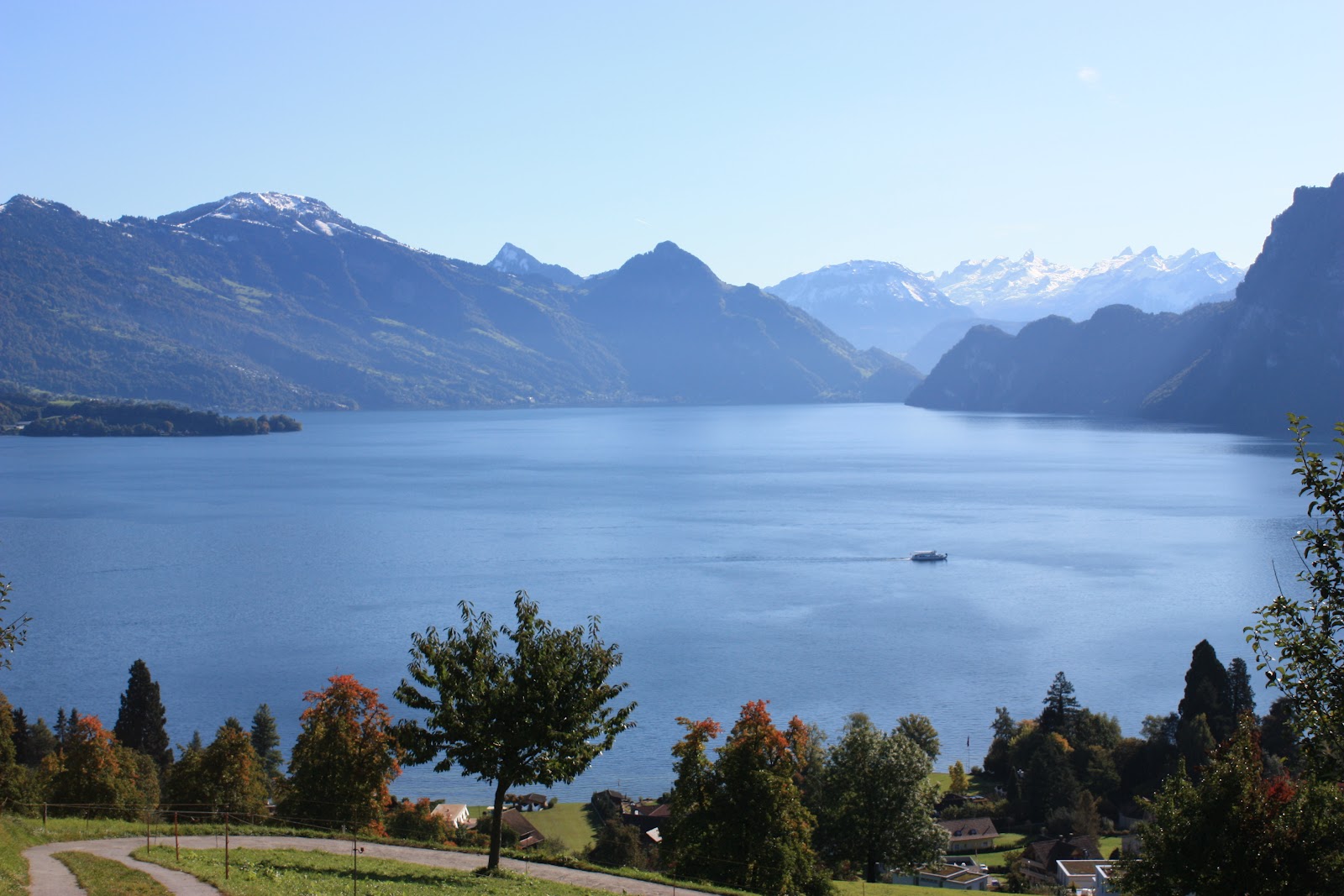


Which is a good thing, because the sailing isn't very exciting. It's very common for the wind to blow at only 3-4 knots, and then get lighter still in the middle of the afternoon. It's a pleasant surprise when the boat moves faster than 3 knots, and not uncommon to be moving at less than 1 knot. Like I said, relaxing.
But the scenery makes it all worthwhile, and we really do enjoy being out on the water, in the sunshine, enjoying the feeling of being propelled, almost silently, solely by the wind.
Monday, May 21, 2012
Back in Switzerland
We had a very smooth flight from Grenada to London, and spent several hours with Gretchen's nephew, Griffin. He has been interning at the House of Commons for the past several months, and he have us an insider's tour of Westminster Palace and the Parliament offices. We particularly enjoyed the small Chapel of St. Mary Undercroft, which is located beneath Westminster Hall. It is beautifully decorated, and we feel privileged that we were able to see it.
After a night in a hotel near Gatwick, we took the bus to Heathrow, and finally returned to our apartment in Meggen.
After a night in a hotel near Gatwick, we took the bus to Heathrow, and finally returned to our apartment in Meggen.
Friday, May 11, 2012
End of the Season
Well, we all know that time goes by very quickly. Suddenly we find ourselves at the end of the 2012 sailing season.
We have been in Grenada for 10 days, anchored in Prickly Bay. This time was mostly devoted to boat chores, all the big and small tasks that need to be completed before we can leave the boat. Mostly putting away and cleaning. Yesterday Callisto was lifted out of the water by a big crane, and transported to the spot where she will remain until next winter. It is amazing the very large and very specialized machines that are used to transport vessels weighing many tons.
We have a few more days of chores, things that are best done when the boat is out of the water. Again, mostly putting away and cleaning. The we fly to London for a night, where we will visit our nephew who is at the Parliament. He has offered to give an insider's tour of the Parliament building, which we are very excited about. Then another flight to Zürich and a train home.
We made a total of 42 passages this year, ranging from 1-11 hours. This was a total of 1,109 nautical miles and we averaged 5.6 knots. We did quite a bit more sailing this year than last, and found that we really enjoyed the time on the water. We also did more hiking this year, and really enjoyed the walks, but also enjoyed meeting and interacting with the guides. Among the highlights of the season, though, were meeting up with friends and family on Antigua and St. Martin, and interacting with cruising friends in the islands.
All in all, a great season! But we have lots waiting for us in Switzerland. Gretchen has already signed up for a golf tournament, and David will perform in a one-act play as part of a theater festival in Antwerp, Belgium, at the end of the month. And, of course, lots of Swiss friends to see again.
Thursday, May 3, 2012
Carriacou Maroon and String Band Music Festival
Sorry about the long interval between posts. We've been very busy, and have not always had good internet connectivity.
After hiking on Dominica, we really enjoyed a long and strenuous hike in the rainforest on St. Lucia. One key difference: on St. Lucia there is a lot of commercial (illegal) marijuana being grown. Very important to have a guide, so that you don't accidentally stumble on a ganja plot, and make a Rasta very angry. The trail was beautiful, and we took a side trip down a ravine to visit the en bas Saut waterfall. This whole area was greatly affected by Hurricane Tomas in 2010. The effects of numerous mudslides and severe flooding were still very much visible.
One of the highlights of our season was the Carriacou Maroon and String Band Festival. This is the third year they have run it, and it is attended by an interesting mix of locals and tourists.
Maroons were runaway slaves who formed independent settlements together. On Carriacou, the word is also used to refer to an event that commemorates the Maroon culture and heritage. The Grenadian tourist board has combined this celebration with a music festival that focuses on string bands: guitars, banjos, mandolins, etc. We had not known that string band music was a big thing in the West Indies, but once we saw a lavender violin played with a baby-blue bow, we were convinced.
The first night of the festival was the Maroon event. This took place in the village of Belmont, on the southeast part of Carriacou. It was basically a big community meal. Traditional foods were served in huge quantities to all comers -- and no one would take our money. Lots of people having a good time and enjoying each others company.
The second day featured a series of String Bands playing along the main street in Hillsborough, the largest town on Carriacou. Great music, but played at a typical Caribbean volume level (loud!) In the evening, everyone moved to a park in Belair, north of Hillsborough. There we saw many different groups from around the Caribbean demonstrating traditional dances and traditional music.


The evening continued with more String Bands, but it was after midnight and past our bedtime.
The final day saw more String Bands playing on the fabulous Paradise Beach. Good beer and lots of souvenirs to invest in.
All in all, a great event to mark the closing of our 2012 season.
We are now in Prickly Bay, Grenada, preparing the boat to come out of the water in a few days. Lots of chores, mostly cleaning, and we are very much hampered by an unusual period of rainy days. A bit wistful about leaving the wonderful islands, but excited to be returning to friends and activities in Switzerland.
Wednesday, April 11, 2012
Hiking on Dominica
Dominica is one of our favorite islands. In addition to very friendly people, it offers breathtaking natural beauty.
We took three guided hikes this visit. Two were on segments of the national trail system, the Waitukubuli Trail. First we hiked in the rainforest, at Morne Diablotin. Lots of water (and mud), the trails were covered with wet leaves that made walking tricky. The highlight of this segment was the chance to see numerous parrots. These birds are unique to Dominica, endangered, and a source of immense pride for the Dominicans. They are very shy, so we mostly saw them flying away from us. We also saw numerous land crabs.
The second segment goes through the forest between the villages of Capuchin and Penville. This trail was much dryer, and it reminded us of hikes in Switzerland, since there was a lot of up-and-down terrain. The views were spectacular, wooded valleys in one direction, the islands of Guadeloupe in the other.
Our third hike this trip was to visit Victoria Falls. This was a very challenging journey, since it requires clambering over boulders that range in size from a basketball to a car. Many of the boulders are slippery, and we had to ford the river three times. But it was worth it:
A truly spectacular falls. Its hard to tell from the video, but this is well over a hundred feet high,
At the end of the hike, we had another treat: a meal at the "Rastaraunt" run by Moses at the trail head. Moses has a farm here, with all kinds of fruits and vegetables. He made us a soup with greens, yams, plantains, beans and who knows what else. The broth contained lots of coconut milk. Very delicious and filling.
Saturday, March 31, 2012
Marie Galante
The nation of Guadeloupe consists of two large islands, and several smaller ones. All are considered a Department of France.
One of the smaller islands is Marie Galante. This is a quite unusual island for the Caribbean. From the sea, it looks flat as a pancake. Quite a contrast from the typical steep slopes and mountainous terrain we usually see.
Because it is so flat, Marie Galante has historically been an agricultural center. There is still a lot of sugar cane grown there.
We like the island because it is a great place to go hiking. The government has established several trails across the island. We have learned the hard way that the maintenance of the trail markings has been small to none, but the island is small and it is hard to get too far off the track.
As we were hiking this visit, we noticed that there seemed to be an unusually large number of cattle, and especially bulls. This seemed odd, because how many bulls does such a small island really need? Then it struck us: these weren't bulls after all -- they were oxen. The residents still use oxen to haul sugar cane from the fields to the mill.
Some sailors think that Marie Galante isn't a good place to visit, because the anchorage is quite wide open. Our experience has been that the anchorage is quite pleasant. There is protection from big seas from the main part of Guadeloupe. It would probably be quite rolly after a prolonged period of strong winds from the northeast, but that is quite unlikely this late in the year.
We had one unexpected adventure on Marie Galante. We had decided to visit the village of Capesterre on the windward side of the island. It has a reputation for having a great beach, protected by nearby reefs. We had planned to take a taxi, but none were to be found when we arrived on the island. The tourist office suggested a local bus. That sounded like fun, and a way to save money, too. It took two buses: one to the town of Grand Bourg, and then a second to Capesterre. The beach was wonderful, and we had an excellent lunch in Le Galette, a restaurant right on the beach. After lunch a bit more time in the water, and then time to go home. We walked back to the village, only to discover that the buses stop running at 1:00 pm on Wednesdays (guess what day of the week it was). What to do? More than 20km back to the boat, no taxis, and no bus. Well, we walked back to Le Galette and begged for help. They tried calling a taxi for us, but no answer. Finally, one of the people there volunteered that her friend needed to head in that direction, and she called him and asked him to give us a lift.
Herve runs the Sa Ka Plonje dive center on Marie Galante. We were extremely grateful that he was willing to help us out. He has excellent English, and was just generally a nice person. During the trip to Saint Louis, we talked about dive schools. We learned a lot about the advantages of smaller operations. We will certainly think hard about arranging a course when we visit Marie Galante next year.
Subscribe to:
Posts (Atom)

