Saturday, February 2, 2013

Ashore in St. Lucia

On many islands, there are several favorite sites to bring tourists.  Taxi drivers string them together into half-day or longer tours.  These can be kind of kitschy, and on Cruise Ship days they can be crowded, but they can also be very nice.

We took one of these tours, and visited three sites.  First was a place called Tek Paul.  (pronounced "Tea")  This was a 45 minute hike through forest and farm, and is famous for its views.  At various places along the trail you can see the valley of Chateaubelair, both Gros Piton and Petit Piton (the famous Lucian mountains, and a world heritage site), and the village of Soufriere.  We really liked the views, and it was great to stretch our legs after a few days on the boat.

Next we visited a volcano.  This is the only place in the Caribbean where you can drive into an active volcano caldera.  39,000 years ago there was a big eruption here, and the magma is still close to the surface.  You see lots of mist, from rain water contacting hot rock.  Pools of water are literally boiling, but look black and viscous from the suspended iron sulfide.  The rocks in the area are stained with sulfur, copper, and iron.  We are told that there are actual geysers, but only at the time of the full moon.

Finally we visited a very pleasant botanical garden.  This was built by a father and daughter who owned the property and surrounding plantation.  There are many, many beautiful tropical flowers, along with examples of the typical Caribbean fruits -- mangos, cashews, nutmeg, soursop, citrus, pineapple, coffee, and cacao.  A feature of the garden is the unusual Diamond Falls.  The water in this waterfall is the run-off from the volcanic caldera we visited.  It is hot, and black, just like at the volcano.  The rock under the falling water is brown with sulfur deposits.  For a few dollars, you can soak in a pool with water from the stream (thankfully not black!).  We hadn't brought our bathing suits, and skipped it this trip.


Monday, January 21, 2013

Scuba Lessons


David first got interested in Scuba in the 60’s, and even studied some of the written materials then, but never went on to take lessons.  Our friends, Jill and Rod Hearnes, are avid divers.  They are even older than we are, and their example showed us that it is never too late to get started.   So we decided last spring that we would book a Scuba course this season.

The course is sponsored by an international organization called PADI.  There are several groups that certify divers, but PADI is one of the biggest.  There is quite a lot of book learning that you need before starting to dive, and you can take an online course that covers this material.  Both Gretchen and I completed the online course while we were in Switzerland last fall.

When we got to Bequia, we started the practical part of the training.  First, you learn some basic skills in “confined water,” which in this case means “shallow and relatively still.”  I.e., a few yards off the beach in front of the dive shop.  Then you repeat these exercises in “open water,” which translates to “deeper.”  There are a total of 8 or so dives, counting the confined water work.

We found the practical training to be more difficult that we had imagined from the online materials.  The specific skills (e.g. clearing water out of your mask, finding your mouthpiece after losing it, sharing air with a buddy if you run out) are actually pretty straightforward.  What we found challenging was even more basic:  controlling buoyancy and equalizing our ears.

When you are diving, you have a weight belt to help you sink.  You also have a jacket-like device that can be inflated to help you float.  It seemed like all it would take to control buoyancy is to get the proper balance between the two.  But it was not so simple.

The other thing that affects your buoyancy is your lungs. If you take a deep breath, your lungs expand and this makes you float.  If you exhale strongly, your lungs get smaller and you sink.  But of course, you are inhaling and exhaling constantly.  It proved quite difficult for both Gretchen and David to control this.  On our first couple of dives, we were bobbing up and down in the water like yo-yos.

Well, bobbing up and down just adds to the second problem:  equalizing our ears.  As you descend, you have to add air to your inner ears, in order to balance the increasing pressure from the water outside.  It’s kind of like the pressure on your ears when you are on an airplane that is landing, except more intense.   Equalizing your ears is a learned skill, and becomes easier with practice.  But of course, on our first dives, we didn’t have much practice – and needed to equalize a lot because of our constant descending and ascending.  If you get this wrong, it hurts!

On the second dive, Gretchen got so frustrated that she was crying into her mask.  She couldn’t stay down on the bottom.  Her ears hurt.  David wasn’t in much better shape.  We had to take a pause, and deal with these two basic issues before we could continue.  The dive shop (DIVE BEQUIA) was extremely patient and accommodating.  We scheduled a dive where we focused only on these two skills.  By the end of the dive, we both were feeling much more comfortable and relaxed.

We still have two dives to go, but the skills in each of these dives should be learned and demonstrated without too much trouble.  Then we will be certified divers!


Commissioning


After sitting in the boatyard for several months, it always takes some time to get Callisto ready to sail.  There is general clean-up, buying and stowing provisions, refilling propane tanks, and all the rest.  We can generally launch the boat after 3 days or so of work, but there are inevitably many chores still to be done before we can sail.

This year, like last year, we initially had a lot of trouble with the outboard engine on our dinghy.  These little motors simply do not like to be left sitting in the tropical heat for months at a time.  We had actually (at the last minute) asked the boat yard to check out the engine before we launched, but we had troubles anyway.  A big part of this was due to the fact that the mechanic had switched two fuel lines when reassembling the engine.  It took David a couple of days to figure this out.  Then, because of the huge rainstorms that we experienced at the time, we got some water in our fuel tank.  This is not a good way to make an engine happy.  We finally got everything sorted out, though.

All last year we had a problem with the instrument that tells us wind speed and direction.  It worked maybe 5% of the time.  So, when we laid the boat up in May we asked the local technicians to fix it while we were away.

Well, of course, nothing was done until we arrived in Grenada in December.  Then we had to order parts.  These come from Sint Maarten, and are supposed to arrive in Grenada within 7 working days.  This is wildly optimistic when the 7-day period straddles Christmas and New Year’s.  So, we had to sit around the harbor for another week, waiting for the parts to arrive.

This allowed us to experience the fabulous Hash House Harriers.  This is an organization on Grenada (and in other countries) that arranges treks through the woods.  The trail maker (“Hare”) puts small clumps of shredded paper to mark the trail (sort of Hänsel and Gretel in the 21st century).  There are intentional false trails.  And there is mud.

Some people run, and some walk, and some do a mixture.  It is usually pretty rugged, but always beautiful.  A hundred, or even two hundred, people participate.  And after the journey, there is cheap beer and local food.  Great fun.

Finally, parts arrived, were installed, and off we sailed for Carriacou.  After a couple of days on that island, we cleared out of Grenada and sailed to Bequia, in St. Vincent and the Grenadines.

Saturday, December 22, 2012

Launch!

We had a very, very long day traveling from Switzerland to Grenada.  We spent the night in a hotel near the airport in Zürich, and set the alarm for 5:00 am to catch a 7:00 am flight.  Three flights later, we arrived at our hotel in Grenada at 10:00 pm.  With the time zone change, that adds up to 22 hours.  But great to be here!


We spent two days buying provisions, unpacking, and generally cleaning up the boat.  Lots and lots of stuff to put away.  Then, on Wednesday, we launched.

We have been at anchor since then, continuing boat chores and provisioning.  We are waiting for some replacement parts for our instruments, so we will be in the area for at least another week and a half.  We are hoping to participate in an event sponsored by the "Hash House Harrier" which is kind of a goofy walk/run/drink event.  You can find out more at http://www.grenadahash.com/home.  Hopefully, we'll soon have some time for relaxing.

Sunday, December 2, 2012

Nearly Time

As the darkness of winter descends in Switzerland, we are counting the days before our transition to the Caribbean.  We had a lovely day today, with a bit of sun in the afternoon, and a beautiful snow-covered landscape in all directions.  But the sun is up late and down early, and the forecast is for clouds, fog, sleet and snow.

We have been working on our to-do lists for launching the boat, our provisioning plans, and our (very preliminary) itinerary for the season.  This is fun --- helps us focus on the sunshine to come and not on the "hochnebel" (fog) of today.  We are also starting to feel a bit sad about leaving our Swiss friends for such a long time.  And looking forward to seeing our Caribbean friends again.

Sunday, November 18, 2012

Getting Excited

As the days in Switzerland get darker and foggier, we are starting to think more and more about the start of the cruising season.  We have about a month to go, and have already started putting together to-do lists.  We have been in touch with some of our cruising friends, and have very tentative ideas about meeting up with them.  We have been inviting family and friends to visit us during the season, but so far no takers.

Friday, July 27, 2012

Lazy Days of Summer

We spend our summers in Switzerland, and also enjoy sailing here.  It's a very different experience than sailing in the Caribbean, though.

We have a small keelboat, a Beneteau 21.7s, that we sail on the Lake of Lucerne.  The "Baby Beneteau," named "Little Dipper," is 21 feet long and has a keel that can swing up in shallow water.  She has a small cabin where you could take a nap if you wanted, but not really very much in the way of accommodations.

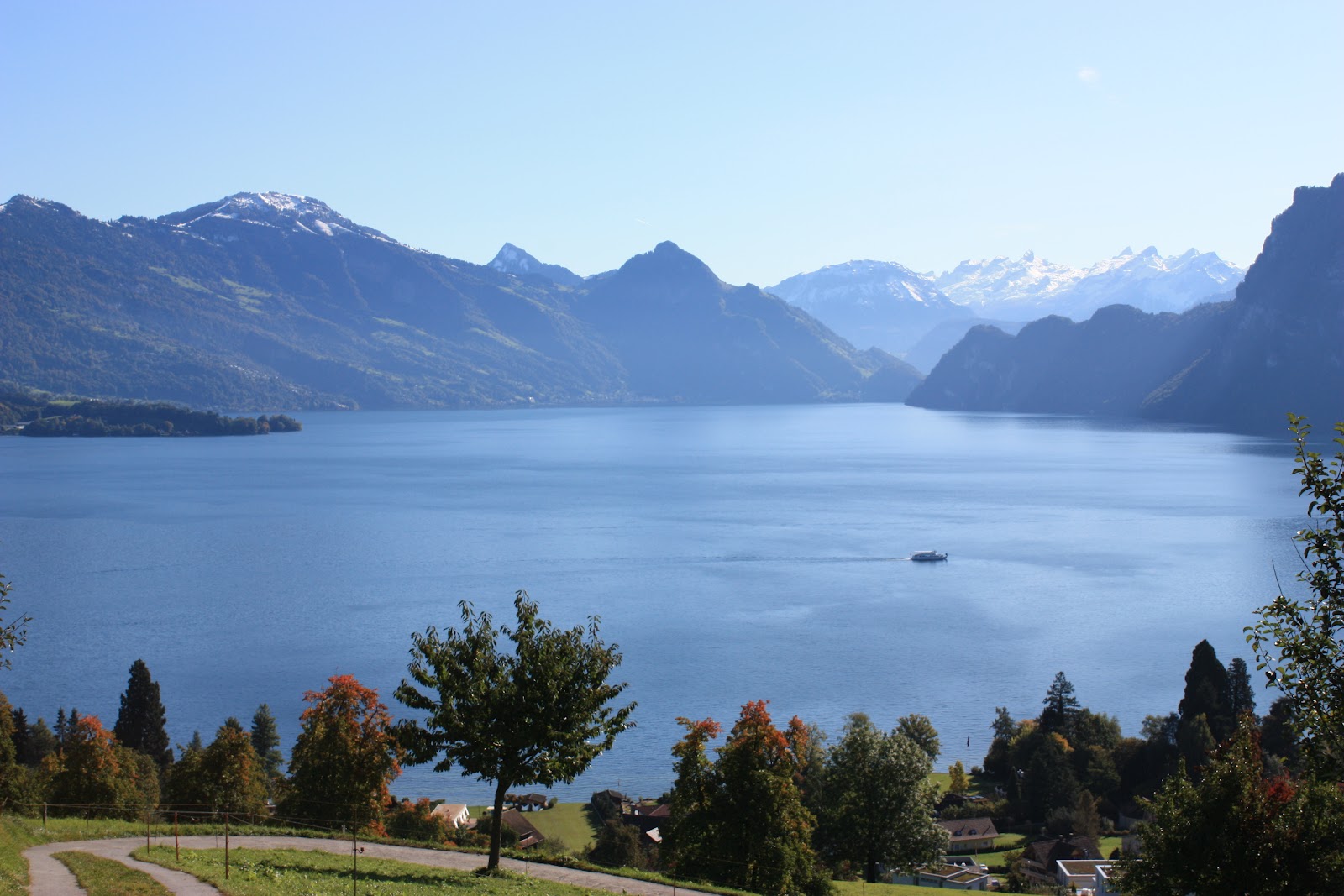
Sailing here is usually a very relaxing affair.  The scenery around the lake is absolutely beautiful:


Which is a good thing, because the sailing isn't very exciting.  It's very common for the wind to blow at only 3-4 knots, and then get lighter still in the middle of the afternoon.  It's a pleasant surprise when the boat moves faster than 3 knots, and not uncommon to be moving at less than 1 knot.   Like I said, relaxing.

But the scenery makes it all worthwhile, and we really do enjoy being out on the water, in the sunshine, enjoying the feeling of being propelled, almost silently, solely by the wind.