Wednesday, March 4, 2015

Chile, Part 2


This is the second of two blog posts describing our visit to Chile.  This post will cover our time fly fishing in Patagonia.

We first heard about the Patagonian Basecamp from our old friend, John Landis, in the summer of 2013.  John is an avid fly fisherman, and has fished in many remote places around the world.  When he heard that David had given Gretchen a fly rod for her birthday, he told us about the Basecamp, and  suggested that we join him for the trip he had already scheduled in early 2015.

We found the Basecamp website at www.patagonian-basecamp.com, and were enthralled by the pictures and descriptions of the program.  This is a very pricey vacation for our retirement budget, but we were approaching our 30th wedding anniversary, and decided to give the trip to each other as part of the celebration.  The Basecamp is run by Marcel Sijnsesael, who is passionate about trout, fishing, and keeping his guests happy.

That was all very good, but neither of us knew how to fly-fish, and David had no equipment at all.  To the rescue came Jon Toft, a British man who at the time ran a small business in Switzerland, “Have-a-go-Flyfishing,” which specialized in fishing lessons.  During 2014, we spent two full days with Jon,  and found him to be an excellent instructor.

We left Santiago, flying south toward Patagonia.  Our first leg was to the town of Puerto Montt.  This small city (about 350,000 inhabitants) is at the center of the main agricultural region of Chile, and supports a very large and growing fish farming industry.  From Puerto Montt we traveled by taxi to the tourist resort Puerto Varas, where we spent two nights.

We liked Puerto Varas a lot.  It is on a large lake, Lago Llanquihue. On a clear day, you can see the peak of the volcano Mont Osarno across the water. 


The town is almost exclusively dependent on tourism, and treats its visitors very well.  The tourist office gave us a map that showed a walking tour that highlighted the oldest 10 or 12 buildings (mostly homes) in the city.  We had a good time walking through some of the less-commercial neighborhoods, and seeing the old buildings.  They were constructed mostly from 1890 to 1910.  Each house had a placard that explained the original owners, and the kinds of wood that were used.

This region had many immigrants from Germany, starting around 1850, and their influence is easily seen in the architecture.  Almost all buildings are made from wood, and the style very reminiscent of German villages.  A couple of times, when our Spanish was too poor to get by, we were able to communicate using German.

From Puerto Varas, we took a charter flight to the village of Chaitén, which is the doorway to Chilean Patagonia.  Chaitén had been the provincial capital, but the town was almost completely destroyed in a volcanic eruption in 2008.  It is being reconstructed, but is much smaller now.

From Chaitén, we rode in pickup trucks about two hours to the Basecamp.  At the moment, the main road is mostly gravel, but there is a big project to pave it, supposedly to be completed this year.  That will make the trip to the Basecamp much quicker and easier on the guests.


Each day, we traveled to a different fishing spot.  There were always two guests and one professional guide.  Usually we had a boat to fish from, as well.  Here is a brief description of the places we visited.

Lago Rosselot
Our first fishing day, the lodge wanted us to focus on improving our casting, so we fished on a large lake where we didn’t have to worry about catching our lines in trees.  The scenery was exquisite.  We could see trout approaching our flies, but they always refused them.  We fished hard all day, in many different parts of the lake and using many different flies, but never did land a fish.  Our guide that day was also named David.

Rio Rosselot
The second day, we drifted down the river that exist Lago Rosselot.  Our guide was Craig.  This is a spectacular stretch of river, and we were thrilled to catch our first fish of the week.  Gretchen caught a nice rainbow trout first, and David followed up with a (very) small rainbow a few minutes later.  We both caught several additional fish through the day.  This river features some serious rapids, and we were impressed with Craig’s skill at maneuvering through them.  We were a bit surprised to find that we had to don life preservers and helmets before we went through the white water.


Rio Claro Solar
The lodge uses this name for the stretch of river after the Claro Solar joins the Rio Quinto.    Our guide was Zack.  We each caught several rainbows and a couple of brown trout.  Again, quite a bit of whitewater.  The river level was lower than it had been earlier in the season, and it was interesting to see Zack mentally picturing a way through the rocks before we attempted the pass.  Another truly beautiful stretch of water, and we had it all to ourselves.


Rio Quinto
We had asked for a bit of a break from the “all fishing, all the time” routine, and this was the compromise that Marcel offered.  We would fish, but instead of driving and boating to the site, we would hike.  Our guide was the very young but very enthusiastic Donovan. We walked along the edge of the river for about two hours, and then came to some very good fishing spots, where we each caught a couple of rainbows.  A quick lunch, a few more minutes of fishing, and then 2 hours hiking back.  A very nice change of pace.


Upper Figueroa
The Basecamp offers a couple of much-more-rustic secondary camps, and we were fortunate to be able to spend a night at their Temple camp.  We drove quite a distance to the camp, dropped off our gear, and drove a bit further with a boat to the river entrance.  That left plenty of time for a drift down the river, fishing as we went.  Zack was our guide again.  The river here flows through an amazing rocky canyon, not too high but very rugged and extremely beautiful.  Again, we had significant rapids to traverse, and had to get out the helmets again.  Several fish found their way onto our lines in the spaces between the rapids.  Again, we were impressed with Zack’s technical expertise and physical skill in managing the whitewater.


Rio Pico
We spent the night in Temple Camp, which is about as luxurious a camping experience as you will ever find.  The guides call it “Glamping,” glamour camping. Each tent had a propane heater, hot-water shower, and a flush toilet.


The final fishing day of our trip was on the Rio Pico with Donovan.  We decided to put on our waders and walk the river, fishing whenever we got to a suitable spot.  We had to cross the river twice, and found the first crossing very difficult, trying to keep our balance on big rolling boulders in a fairly strong current.  Donovan scouted out an easier spot to cross back, fortunately.  We had a great day.  On the last cast of the last day, David caught this:


Home Again, Home Again
On Friday, we drove by truck and Subaru back to Chaitén, caught the charter flight to Puerto Montt, and flew back to Santiago.  By the time we arrived, it was after 9:00 pm.  We had booked a night in the airport hotel, which allowed us a good rest before flying back through Bogota and Curaçao.

We are really glad we took this trip, it was definitely something to check off on the bucket list.

Monday, March 2, 2015

Chile


This is the first of two blog posts describing our visit to Chile.  This post will cover our preparations and the time we spent in Santiago.  An upcoming post will describe our fly fishing experience.

The trip was scheduled to last a bit more than two weeks.  In Bonaire, it is not permitted to leave a boat unattended on a mooring, so we arranged to move Callisto into Harbor Village Marina.  This is quite a pleasant marina, and very reasonably priced.  We don’t have all that much experience bringing Callisto into marina slips, but we accomplished it without drama (and a little help from the marina staff).  The  marina manager gave us a letter that said they would be responsible for Callisto while we were gone.  We had to give this to Customs as part of leaving Bonaire.

We took a short commuter flight to Curaçao, and then started south.  Our first leg was on Avianca, the Columbian national airline, to Bogota.  We were very impressed with the sparkling clean Airbus 320 and with the very modern Bogota Airport.  The shopping area, including duty free, was amazing.  David was taken with the scantily clad young ladies who stood outside each shop and encouraged customers to come in.

It was a long over-night flight from Bogota to Santiago, but we got to experience Avianca’s brand new Boeing 787 Dreamliner.  Extremely quiet and comfortable, with a very up-to-date entertainment system.

In Santiago, we were met at the airport by an English-speaking driver who gave us some tips on the city while we were riding to the hotel.  We were relieved that our room was available even at 8:30 in the morning, and took advantage to catch a nap.

We really liked Santiago.  It was simply a very comfortable place to wander around.  Lots of people on the streets, nobody in too much of a hurry.  Despite some practice, our Spanish is still not too good, but the people we met were patient, and many knew some English.

Santiago is roughly the same distance from the equator as Charleston, SC.  February is high summer there, and we experienced daily high temperatures around 30C, or 85F.  It got much cooler over night, with lows below 10C (50F).  The altitude is just about the same as our home in Meggen, 520 meters above sea level.

There are two big hills in the center that have been made into city parks.  We visited Cerro Santa Lucia on one day, and Cerro San Cristobal a couple of days later.  San Cristobal has a funicular railway to the top (felt like being in Switzerland).  We chose to walk up and take the train back down.  The views from both hills were excellent, and we met lots of locals enjoying the parks with their families.
Reflection of Cerro Santa Lucia in a modern building

We visited a couple of museums, one specializing in pre-Columbian art and the other in paintings by Chilean artists.  Both were very good, with interesting objects well presented.

One of our favorite places was the fish market.  Fish is a very important cuisine in Santiago, and the market supplies fish to all the restaurants.  We saw lots of fish laid out for examination by potential buyers.  The building also houses numerous restaurants, and is a favorite place for Santiago residents to get lunch.  We had a really good meal in one of them.


One day we took a bus tour to the cities of Viña del Mar and Valparaiso.  Valparaiso was once the jewel of Chile, since it was the first really good harbor that ships came to after rounding Cape Horn.  The harbor was greatly affected by the opening of the Panama Canal, and the city has been in a long decline, with a population only half of its peak.  There is a tradition in the city of asking art students at the university to paint murals on houses and buildings, and many of these were quite spectacular.


We had a brief boat tour of Valparaiso Harbor, which still seems plenty busy to me.


Viña del Mar is a thriving resort city very near to Valparaiso.  Many Chileans come there for holidays.
 
After only a few busy days in Santiago, it was time to head south.

Wednesday, January 28, 2015

Donkeys

Donkeys were brought to Bonaire starting in the 17th century as beasts of burden.  They were used that way right up to the 1940's, but were replaced eventually by motorized vehicles.  The remaining donkeys were released into the wild, and have been living on their own since then.

Wild donkeys have a tough time.  Water is scarce and unreliable.  Food isn't much easier to come by.  Many wild donkeys are dehydrated and malnourished.  Many others are killed or injured in collisions with cars.  A baby donkey who loses his mother is in a terrible situation.  There are about 150 of these poor animals roaming the desolate parts of the island.

Enter the Bonaire Donkey Sanctuary.  This organization was founded more than 20 years ago to provide care for malnourished or injured donkeys.  The Sanctuary has more than 140 acres of land, and over four hundred donkeys live there.

There is a separate compound for "senior citizens," one of which is more than 40 years old.  A second compound is devoted to new mothers and their babies.

For a small fee, it is possible to drive through the Sanctuary and get up close to the donkeys.  Visitors are encouraged to buy bags of carrots, and the donkeys know very well that a car or truck driving by is a chance to get a treat.  Our car was surrounded by up to dozens of donkeys all hoping for a carrot.  We had as many as 6 or 8 donkey noses pushed through our car windows at a time, and some of the donkeys would trot along side as we drove slowly through.  A bit overwhelming at times, but incredibly fun.

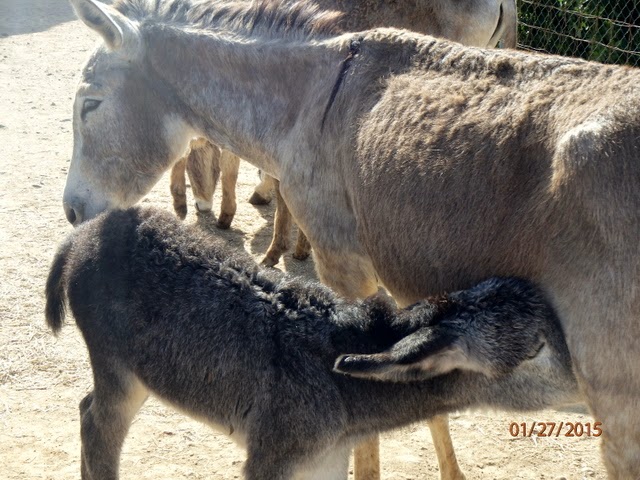
The Mom&Child compound was also wonderful.  Foals ranging in age from 1 week to 3 months were there, and still nursing from their mothers.  Especially the young ones have soft hair, but everyone (including the Moms) was happy to get petted and stroked.

Anyway, the Sanctuary is a very good cause.  They neuter all the animals in the Sanctuary, and are trying to do the same for the remaining wild donkeys.  You can find out more at Bonaire Donkey Sanctuary, and you can make a donation online.

Here are some photos of our visit.

A few donkeys checking us out.  Many more joined them later.

Noses through the window, searching for carrots

This fella is just one week old

Mom's milk is the best food

Tuesday, January 20, 2015

Turtles!

Yesterday, we took a long dinghy ride with our friends Rick and Lila to the small island of Klein Bonaire.  There are 24 designated dive sites on Klein Bonaire, and we hoped to see a turtle.  We did!

The ride to the Bonaventura dive site on the south shore of the island is over 1.5 nautical miles from Callisto.  In the dinghy, that took us a little over 20 minutes.  Going so far is always a bit nervewracking.  Will the engine quit?  Will we run out of gas?  Its a very long row upwind if you have a problem.  We took two precautions:  1) We chose a day with lighter than average winds, and 2) We had our friends along, in their dinghy so each could help the other if we had a problem.

It was a spectacular dive, with lots of soft and hard coral, many interesting sponges, and numerous species of fish.  We especially liked to see the "Papa" Sergeant Majors.  These male fish are usually silver and yellow with vertical black stripes.  When they are protecting their eggs (yes, its the male that does this), the yellow markings turn a deep blue.  They also get quite territorial, darting around and trying to chase you off.  We saw lots and lots of fish in this stage, which I guess will help the future population of Sergeant Majors in the region.


As we approached the halfway part of our dive (about half our air gone), swimming strongly toward us was a hawksbill turtle.  It was surprisingly deep, about 40 feet.  The animal was moderate in size, perhaps 18 inches long.  It swam directly at us, passing only a couple of feet below us before continuing on its way.  A real treat.

We returned to the boat mooring at a shallower depth, still enjoying all the sealife.  As we neared the boat, Gretchen spotted a second turtle.  It was motionless at the bottom in about 20 feet of water, apparently fast asleep.  This was a green turtle, a bit larger than the first, maybe 24 inches.


Seeing these increasingly rare animals is a very special experience.  They are endangered by hunting, and also because of loss of habitat, especially undisturbed beaches for egg-laying.

Note: Photos retrieved from the internet.  We didn't bring our camera this trip.

Friday, January 9, 2015

More Gazing


09 January 2015

More Gazing …


Yesterday we also went “fish” gazing.  We bicycled about  11km (6 miles) to a dive/snorkel site named “Tolo”.   The site is known for its large specimens of soft corals and sponges, in addition to fish.   It has been very windy here the past week, and when we arrived at the dive site, we realized that all the wave action had piled up on the coast where we planned to snorkel.  It was way too rough for us, so we turned around and stopped at Eden Beach resort for lunch and then snorkeled along the dive site named “Front Porch”.  The water was not very clear, lots of sand has been stirred up by the wind and waves, but we saw lots of fish taking shelter from the wave action under a large shelf of rock (the front porch?).   The water was too cloudy for our camera, but here are some web pictures of some of the highlights….

Honeycomb cowfish
Blue Tangs
Spotted drum


Porcupine Fish
smooth trunkfish


Stargazing

With the boat at anchor, we often get fabulous views of the nighttime sky.  The conditions on Bonaire are not as good as on some other islands, because there are bright lights all along the shoreline.  But we still see lots of stars and planets.

Last night was especially interesting, because we had three planets all aligned vertically.  At the top of the row was Mars, directly below that was Venus, and closest to the horizon was Mercury.   You don't often see three planets aligned like this.

We were also interested in the sky because a comet is approaching the sun, and this is just about the time you might begin to see it with the naked eye.  The comet is generally in the vicinity of Orion.  Here's a link to information on where to look:  Comet Lovejoy.  We didn't see the comet last night (because of the light pollution, I guess), but we'll keep trying.


"Stargazer" is also the name of a fish, found in Florida and in the Gulf of Mexico.  It is a seriously weird looking creature:


There are quite a few very odd-shaped fish in the world!

Thursday, January 1, 2015

Fireworks

Happy New Year to all, and best wishes for a wonderful 2015!

Every culture has its own traditions for welcoming the New Year, and it is safe to say that the defining characteristic for Bonaire's New Year is FIREWORKS.  There were many locales up and down the coastline setting off colorful and noisy rockets, some associated with resorts but many just family groups and partiers.  The noise started at dusk, and the color display as soon as it became dark.  It all built to a crescendo at midnight, with an unbelievable number of rockets in the air, for a surprisingly long time.  The show lasted into the night, with a final blast just before dawn.

You see some amazing fireworks displays by highly organized groups in big cities.  But this ad hoc event on an island with less than 20,000 residents was the best I've ever seen.