Yesterday we made a passage from St. Lucia to the island of Bequia in St. Vincent and the Grenadines. This is one of our longer passages, more than 50 miles.
In planning the passage, one important question is "On which side of St. Vincent do we travel?" St. Vincent is a large island with many tall mountains. We knew from experience that traveling on the leeward (western) side of the island would mean little or no wind and extensive motoring. We don't like to motor -- it is noisy and diesel is expensive.
The alternative is the windward (eastern) side of the island. You have to be careful to stay well off-shore, since the wind would push you into trouble if you had an unexpected problem. This adds a couple of miles to the journey, but worth it to avoid extended motoring.
The trouble is that, usually, the wind doesn't cooperate. In order to take this more-easterly route, we would need to tack. This means, not a couple of extra miles, but many extra miles.
Yesterday, though, we were in luck. The wind was from the due east, and since our course was basically due south, we could travel without tacking. Seemed like an ideal time to try the windward option.
Unfortunately, there is another factor to be considered. When we started on our southward course from St. Lucia, we discovered that we were facing a very strong, adverse current. The current had both east-to-west and south-to-north components. We face east-to-west currents almost continuously in the Caribbean, but the south-to-north component isn't all that common. And it was flowing at more than 3 knots! We rarely see currents that strong. Perhaps it was due to the new moon.
Well, time to reconsider our plan. If we kept going down the windward side, we would be traveling at only 4 knots or so -- not fast enough to make our anchorage by dark. We changed gears and headed for the leeward side.
On this course, the current was basically pushing us sideways. We could compensate for that by changing our sailing angle, and maintain good average speeds. Plus, while we were behind the island, we would be protected from the east-to-west current. As it turned out, we even experienced a favorable north-to-south current for a few miles along the southern coast.
So, a couple of hours of motoring. Not the end of the world and we have done it many times before. Still, it was a relief to get around the southern end of St. Vincent, set the sails, and turn that noisy machine OFF.
Saturday, April 13, 2013

Thursday, April 4, 2013
Another Day, Another Waterfall
We're always looking for destinations to justify a hike, and waterfalls certainly fit the bill. On Dominica this trip, we've visited two very different ones.
Cruisers in the Caribbean rely very heavily on cruising guides to help them through day-to-day decisions. The most popular by far are published by a company called "Cruising Guide Publications," and two we use most heavily (Leeward Islands and Windward Islands) are authored by a man named Chris Doyle. Chris has been doing this for decades -- our Windward Island guide is the 16th edition -- and he is very influential among both cruisers, but also among the various service providers, restaurants, and shops on the island.
Well, when Martin of "Providence," one of the boat services folks in Portsmouth, Dominica, asked us if we'd like to take a hike with Chris Doyle, it was a very immediate "Yes!" We went to a place not well publicized, called Sherry Falls. This is a relatively easy (35 minute), and extremely beautiful walk through the forest. The falls are modest, maybe 25 feet high, but quite picturesque.
Here's a shot with Chris Doyle and Martin:

The other extreme of waterfall tourism includes several very well-known and well-visited large waterfalls. The most popular is Trafalgar Falls, because it is easily accessible by cruise ship visitors. Another famous one is Victoria Falls, which we visited last year. Today we hiked to Middleham Falls. This is the highest waterfall on Dominica, at 180 feet. It is a much more difficult hike than Sherry Falls, but promoted enough that there is a fairly steady stream of visitors. We saw three other groups during our two-hour hike. Anyway, Middleham Falls is pretty spectacular:
As you can see, we were enjoying ourselves:

Cruisers in the Caribbean rely very heavily on cruising guides to help them through day-to-day decisions. The most popular by far are published by a company called "Cruising Guide Publications," and two we use most heavily (Leeward Islands and Windward Islands) are authored by a man named Chris Doyle. Chris has been doing this for decades -- our Windward Island guide is the 16th edition -- and he is very influential among both cruisers, but also among the various service providers, restaurants, and shops on the island.
Well, when Martin of "Providence," one of the boat services folks in Portsmouth, Dominica, asked us if we'd like to take a hike with Chris Doyle, it was a very immediate "Yes!" We went to a place not well publicized, called Sherry Falls. This is a relatively easy (35 minute), and extremely beautiful walk through the forest. The falls are modest, maybe 25 feet high, but quite picturesque.
Here's a shot with Chris Doyle and Martin:

The other extreme of waterfall tourism includes several very well-known and well-visited large waterfalls. The most popular is Trafalgar Falls, because it is easily accessible by cruise ship visitors. Another famous one is Victoria Falls, which we visited last year. Today we hiked to Middleham Falls. This is the highest waterfall on Dominica, at 180 feet. It is a much more difficult hike than Sherry Falls, but promoted enough that there is a fairly steady stream of visitors. We saw three other groups during our two-hour hike. Anyway, Middleham Falls is pretty spectacular:
As you can see, we were enjoying ourselves:

Wednesday, April 3, 2013
Dominica - Portsmouth
Just a quick note before we leave for Roseau.
We have had a great week in Dominica, as usual! We were very honored to be asked to accompany Chris Doyle (author of the definitive cruising guides for the Carribean) on a hike to a small but beautiful waterfall on Easter Sunday morning. The hike was arranged by Martin "Providence", a very knowledgeable guide. Two other US couples joined as well, Soul Mates from Florida and Sinbad from Michigan. After the hike we took a small northern island tour, which included a visit to "Cold Soufriere". Cold Soufriere is a cold volcano...in essence the gases bubbling up from the earth have come such a long way that they are completely cool by the time they surface. We learned that Dominica is one of the youngest islands in the chain, and that is why there is still so much seismic activity here.
The second highlight of the week was a chance to go fishing with Alexis. He is a very patient man! I fed two fish (meaning did not set the hook) which Alexis said were almost surely kingfish, and David fed three. Finally, I managed to hook and land (with Alexis'help) a barracuda and a jack. The barracuda was very tasty. I steamed it with some Adobo seasoning and lemon grass we collected on the tour with Martin. We are assured that there is no ciguatera in Dominca so it is safe to eat reef fish and reef fish predators. David and I both agreed that having the chance to see the shoreline up close was an added bonus.
Today we are off to Roseau, and hopefully there will be some pics in the camera to add to this post.
We have had a great week in Dominica, as usual! We were very honored to be asked to accompany Chris Doyle (author of the definitive cruising guides for the Carribean) on a hike to a small but beautiful waterfall on Easter Sunday morning. The hike was arranged by Martin "Providence", a very knowledgeable guide. Two other US couples joined as well, Soul Mates from Florida and Sinbad from Michigan. After the hike we took a small northern island tour, which included a visit to "Cold Soufriere". Cold Soufriere is a cold volcano...in essence the gases bubbling up from the earth have come such a long way that they are completely cool by the time they surface. We learned that Dominica is one of the youngest islands in the chain, and that is why there is still so much seismic activity here.
The second highlight of the week was a chance to go fishing with Alexis. He is a very patient man! I fed two fish (meaning did not set the hook) which Alexis said were almost surely kingfish, and David fed three. Finally, I managed to hook and land (with Alexis'help) a barracuda and a jack. The barracuda was very tasty. I steamed it with some Adobo seasoning and lemon grass we collected on the tour with Martin. We are assured that there is no ciguatera in Dominca so it is safe to eat reef fish and reef fish predators. David and I both agreed that having the chance to see the shoreline up close was an added bonus.
Today we are off to Roseau, and hopefully there will be some pics in the camera to add to this post.
Tuesday, March 26, 2013
Nevis
Nevis, part of St. Kitts and Nevis, is a wonderful island, laid back and with very interesting terrain. It has one of the taller mountains in the area, but also more flat areas than many islands. St. Kitts is a cruise ship center, and we noticed that there has been an effort to get more cruise ship tourists to visit Nevis by ferry. Good for the local economy, not so much for cruisers like us.
We took an interesting hike, and visited some ruins of an old estate. On the way, we were directed by a trail-side sign to this very interesting tree:

It is a baobab tree, planted in 1859. An enormous trunk, as you can see.
The estate ruins were also very interesting, though completely overgrown with vegetation and unrestored. Here are a few shots:


This is a kettle used to boil down sugar cane juice into sugar. It is about 8 feet in diameter.

Remains of an old steam engine, and a smaller sugar kettle.

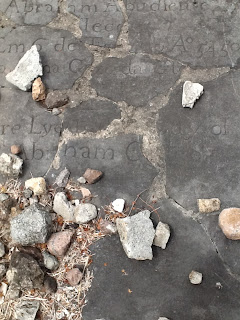
In the 1600's, about a quarter of the non-slave population was Jewish. Ruins of the synagogue still can be seen in the main town, and there is a Jewish cemetery, still very well-kept, near by. We took a few photos of some of the gravestones there:

The stones are placed by visitors to acknowledge the person buried there.


We took an interesting hike, and visited some ruins of an old estate. On the way, we were directed by a trail-side sign to this very interesting tree:

It is a baobab tree, planted in 1859. An enormous trunk, as you can see.
The estate ruins were also very interesting, though completely overgrown with vegetation and unrestored. Here are a few shots:


This is a kettle used to boil down sugar cane juice into sugar. It is about 8 feet in diameter.

Remains of an old steam engine, and a smaller sugar kettle.

In the 1600's, about a quarter of the non-slave population was Jewish. Ruins of the synagogue still can be seen in the main town, and there is a Jewish cemetery, still very well-kept, near by. We took a few photos of some of the gravestones there:

The stones are placed by visitors to acknowledge the person buried there.


Thursday, March 14, 2013
Weather
When we sailed in temperate areas (Great Lakes, New York Harbor, and Chesapeake), our sailing plans were often influenced by the weather forecast. Where we sailed, when we sailed, whether we sailed -- all were strongly influenced by the forecast and by current conditions. Face it, its not any fun to sail in a thunderstorm.
Our experience in the tropics has been very different. Basically, every day is a good day for sailing. We don't like sailing in rain squalls, but the weather forecasts that are accessible to us do a terrible job of predicting squalls. And they are so frequent, especially early in the winter, that you just can't expect to avoid them. There are some variations in wind direction that occasionally influence our routing decisions, but this hasn't been the norm.
This season, however, has been very different. We have been stuck for days because the wind was from an unfavorable direction. The Caribbean has been experiencing severe northerly swells the past few days, and that has influenced our choice of harbors. We have had to postpone sailing because the forecast winds were too light.
Well, its the luck of the draw. We tend to sail whenever we feel it is safe -- and that includes being confidant we will be set the anchor during daylight. Safe for us includes a pretty wide range of conditions. Sustained winds of 30 or even 35 knots are really no problem for Callisto, with the proper sails set. And waves of 10 or 12 feet aren't usually unsafe, though they can be very uncomfortable. Fortunately, we have rarely seen waves that big. Our biggest concern is encountering a squall just as we are entering a harbor. Strong winds and poor visibility can be a real problem when you are trying to maneuver in tight quarters. We sometimes will turn back out to sea, waiting for a squall to pass.
Regarding forecasts, when we have internet we tend to look at a few different websites. Some of our favorites include:
www.windguru.cz
www.passageweather.com
www.predictwind.com
It is very helpful to compare multiple forecasts, since the more they agree, the more reliable the forecast tends to be.
When we do not have internet, we can access weather forecasts through our SSB radio. This is less convenient and the information is more limited, but it is still important to keep up to date with the weather!
Our experience in the tropics has been very different. Basically, every day is a good day for sailing. We don't like sailing in rain squalls, but the weather forecasts that are accessible to us do a terrible job of predicting squalls. And they are so frequent, especially early in the winter, that you just can't expect to avoid them. There are some variations in wind direction that occasionally influence our routing decisions, but this hasn't been the norm.
This season, however, has been very different. We have been stuck for days because the wind was from an unfavorable direction. The Caribbean has been experiencing severe northerly swells the past few days, and that has influenced our choice of harbors. We have had to postpone sailing because the forecast winds were too light.
Well, its the luck of the draw. We tend to sail whenever we feel it is safe -- and that includes being confidant we will be set the anchor during daylight. Safe for us includes a pretty wide range of conditions. Sustained winds of 30 or even 35 knots are really no problem for Callisto, with the proper sails set. And waves of 10 or 12 feet aren't usually unsafe, though they can be very uncomfortable. Fortunately, we have rarely seen waves that big. Our biggest concern is encountering a squall just as we are entering a harbor. Strong winds and poor visibility can be a real problem when you are trying to maneuver in tight quarters. We sometimes will turn back out to sea, waiting for a squall to pass.
Regarding forecasts, when we have internet we tend to look at a few different websites. Some of our favorites include:
www.windguru.cz
www.passageweather.com
www.predictwind.com
It is very helpful to compare multiple forecasts, since the more they agree, the more reliable the forecast tends to be.
When we do not have internet, we can access weather forecasts through our SSB radio. This is less convenient and the information is more limited, but it is still important to keep up to date with the weather!
Sunday, March 10, 2013
Riviere Deshaies
The town of Deshaies, on northern Guadeloupe, is a sleepy little fishing village. It gets a lot of cruising boat traffic because it is a very convenient place to clear customs on the was into (southbound) or out of (northbound) Guadeloupe. The town does its best to extract Euros from the cruisers with a raft of interesting restaurants and a few boutiques.
The harbor is quite good, but fairly small and can get crowded. We always try to arrive by mid-afternoon to make sure we can get a good spot.
If the wind is strong from the east, it gets doubled by the mountain peaks and can really howl. If it is light, you often get a sea breeze at midday, and a westerly wind (very unusual in the tradewind zone). For the first time in the Caribbean, we have been stuck here by weather for a few days. We want to go next to Antigua, which is about 45 miles north of Deshaies. For the last couple of days, the wind has been very light, so we couldn't go anywhere. The forecast for the next few days is for stronger winds, but out of the north -- also not convenient. So we have had a bit more time to explore the area than we planned.
Our trusty "Cruising Guide to the Leeward Islands" recommended a hike up the Riviere Deshaies. It was promised to be a couple of hours. There is no path -- you hop from boulder to boulder, sometimes on the left bank, sometimes on the right bank, sometimes up the middle of the river. It takes some planning and some occasional backtracking. Some of the boulders are as big as Renaults. It is amazing to think about how they got there.
There were numerous pools, and Gretchen had a good time looking for (and finding) fish in them. Many little waterfalls made for a very pleasant sound. It is always a puzzle to us that we so rarely encounter mosquitoes on these Caribbean islands. It sure makes hiking in the forest more pleasant.
After the promised two hours, we came to a road that led past a Catholic religious retreat back into the village. A bit weary, but very glad we made the trip.
The harbor is quite good, but fairly small and can get crowded. We always try to arrive by mid-afternoon to make sure we can get a good spot.
If the wind is strong from the east, it gets doubled by the mountain peaks and can really howl. If it is light, you often get a sea breeze at midday, and a westerly wind (very unusual in the tradewind zone). For the first time in the Caribbean, we have been stuck here by weather for a few days. We want to go next to Antigua, which is about 45 miles north of Deshaies. For the last couple of days, the wind has been very light, so we couldn't go anywhere. The forecast for the next few days is for stronger winds, but out of the north -- also not convenient. So we have had a bit more time to explore the area than we planned.
Our trusty "Cruising Guide to the Leeward Islands" recommended a hike up the Riviere Deshaies. It was promised to be a couple of hours. There is no path -- you hop from boulder to boulder, sometimes on the left bank, sometimes on the right bank, sometimes up the middle of the river. It takes some planning and some occasional backtracking. Some of the boulders are as big as Renaults. It is amazing to think about how they got there.
There were numerous pools, and Gretchen had a good time looking for (and finding) fish in them. Many little waterfalls made for a very pleasant sound. It is always a puzzle to us that we so rarely encounter mosquitoes on these Caribbean islands. It sure makes hiking in the forest more pleasant.
After the promised two hours, we came to a road that led past a Catholic religious retreat back into the village. A bit weary, but very glad we made the trip.
Thursday, March 7, 2013
Diving and Dolphins
We are anchored off the island of Terre-de-Haut, part of the group of islands known as Isles des Saintes or simply Les Saintes. These islands are part of Guadeloupe, which is in turn a department of France.
We love the French islands. The atmosphere is a fun mix of laid-back Caribbean and Continental flair. The Saints depend almost exclusively on tourism, but the competition for tourists' business doesn't ever seem pushy or obtrusive. The one downside is that the restaurants are uniformly excellent, so we spend a lot of money eating out. Neither of us knows very much French (Gretchen knows way more than David), but we get along with little difficulty.
With our new Scuba certifications, we arranged a dive with a local dive shop, Pisquettes. It was fantastic! The fish were incredible, both in number and variety. We are a bit blasé about seeing Sergeant Majors, but we have never seen schools as large as the ones here. We saw trunkfish, triggerfish, angelfish, and some very large Atlantic spadefish. Other treats included some good-sized barracuda, a spotted Moray and a huge lobster. The array of corals and sponges was better than we have ever seen before. A couple of the participants (including David) started the dive with slightly less than full tanks, so unfortunately the dive was a bit shorter than planned.
After the dive, as we were raving about the dive, the dive master asked if we would like to go swim with some dolphins? Well, yes!
There are a couple of dolphins, a mother and a nearly grown calf, who swim most every day in the harbor. The dive boat went in search of them, and we found them with little difficulty. Everyone piled off the boat with snorkels and fins, but the dolphins disappeared. We all got back on the boat, and sure enough they appeared again. This time we cruised around slowly, waiting to see if they would stick around. Eventually most of the divers (David but not Gretchen) got back in the water.
There were quite a few swimmers, some from boats moored nearby, some from the dive boat, some who had come over in dinghy's. The dolphins seemed to enjoy the company. They would slow down so that the swimmers could catch up, and then speed ahead or turn around and dive under us. The pair swam straight toward David at one point, and turned aside when they were within arm's length. Extremely beautiful, and a rare privilege.
We love the French islands. The atmosphere is a fun mix of laid-back Caribbean and Continental flair. The Saints depend almost exclusively on tourism, but the competition for tourists' business doesn't ever seem pushy or obtrusive. The one downside is that the restaurants are uniformly excellent, so we spend a lot of money eating out. Neither of us knows very much French (Gretchen knows way more than David), but we get along with little difficulty.
With our new Scuba certifications, we arranged a dive with a local dive shop, Pisquettes. It was fantastic! The fish were incredible, both in number and variety. We are a bit blasé about seeing Sergeant Majors, but we have never seen schools as large as the ones here. We saw trunkfish, triggerfish, angelfish, and some very large Atlantic spadefish. Other treats included some good-sized barracuda, a spotted Moray and a huge lobster. The array of corals and sponges was better than we have ever seen before. A couple of the participants (including David) started the dive with slightly less than full tanks, so unfortunately the dive was a bit shorter than planned.
After the dive, as we were raving about the dive, the dive master asked if we would like to go swim with some dolphins? Well, yes!
There are a couple of dolphins, a mother and a nearly grown calf, who swim most every day in the harbor. The dive boat went in search of them, and we found them with little difficulty. Everyone piled off the boat with snorkels and fins, but the dolphins disappeared. We all got back on the boat, and sure enough they appeared again. This time we cruised around slowly, waiting to see if they would stick around. Eventually most of the divers (David but not Gretchen) got back in the water.
There were quite a few swimmers, some from boats moored nearby, some from the dive boat, some who had come over in dinghy's. The dolphins seemed to enjoy the company. They would slow down so that the swimmers could catch up, and then speed ahead or turn around and dive under us. The pair swam straight toward David at one point, and turned aside when they were within arm's length. Extremely beautiful, and a rare privilege.
Subscribe to:
Posts (Atom)
